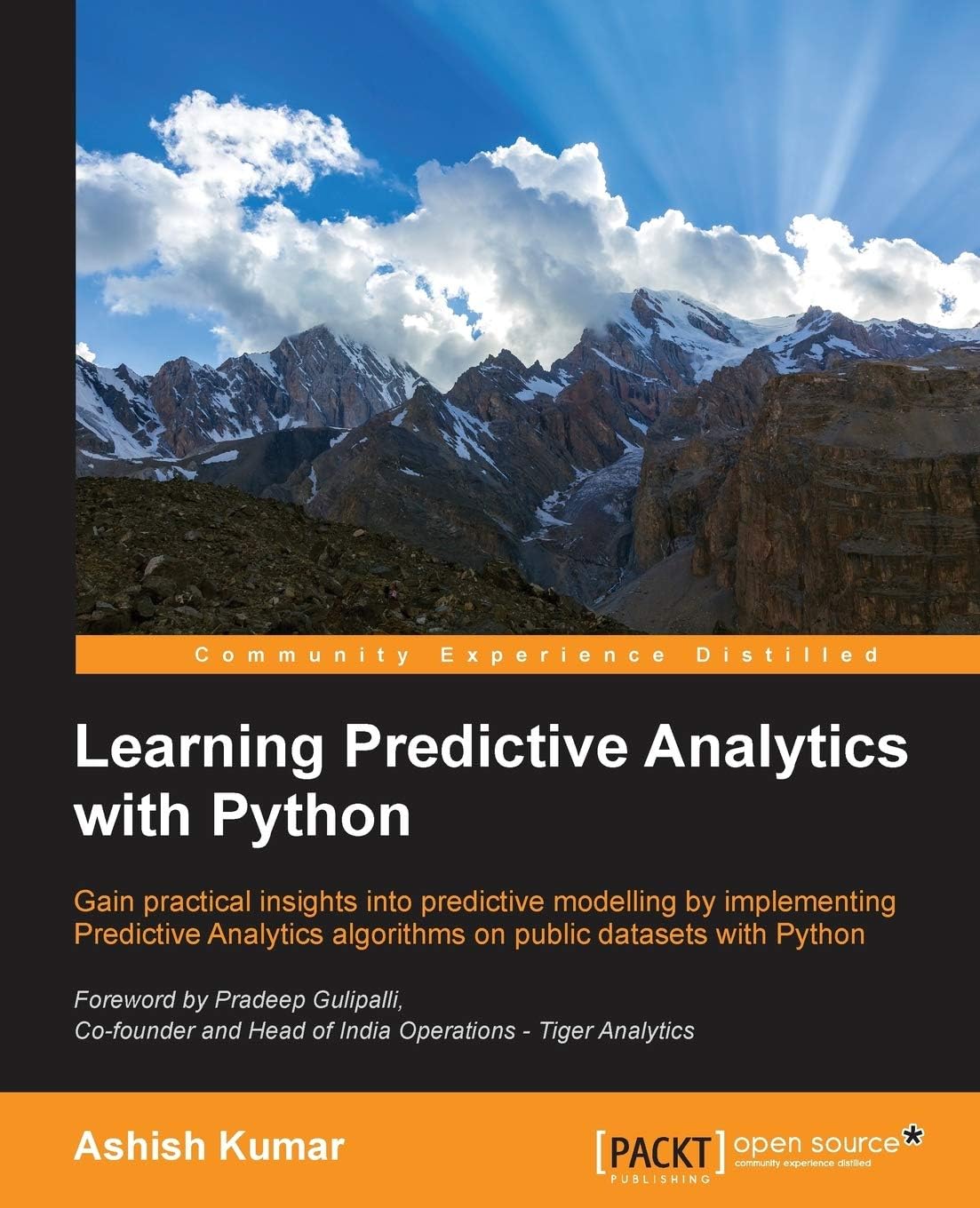
Learning Predictive Analytics with Python
Product ID: 304802052
Buy anything from 5,000+ international stores. One checkout price. No surprise fees. Join 2M+ shoppers on Desertcart.
Desertcart purchases this item on your behalf and handles shipping, customs, and support to Bangladesh.
n practical insights into predictive modelling by implementing Predictive ytics algorithms on public datasets with Python About This Book A step-by-step guide to predictive modeling including lots of tips, tricks, and best practices Get to grips with the basics of Predictive ytics with Python Learn how to use the popular predictive modeling algorithms such as Linear Regression, Decision Trees, Logistic Regression, and Clustering Who This Book Is For If you wish to learn how to implement Predictive ytics algorithms using Python libraries, then this is the book for you. If you are familiar with coding in Python (or some other programming/statistical/scripting language) but have never used or read about Predictive ytics algorithms, this book will also help you. The book will be beneficial to and can be read by any Data Science enthusiasts. Some familiarity with Python will be useful to get the most out of this book, but it is certainly not a prerequisite. What You Will Learn Understand the statistical and mathematical concepts behind Predictive ytics algorithms and implement Predictive ytics algorithms using Python libraries yze the result parameters arising from the implementation of Predictive ytics algorithms Write Python modules/functions from scratch to execute segments or the whole of these algorithms Recognize and mitigate various contingencies and issues related to the implementation of Predictive ytics algorithms Get to know various methods of importing, cleaning, sub-setting, merging, joining, concatenating, exploring, grouping, and plotting data with pandas and numpy Create dummy datasets and simple mathematical simulations using the Python numpy and pandas libraries Understand the best practices while handling datasets in Python and creating predictive models out of them In Detail Social Media and the Internet of Things have resulted in an avalanche of data. Review: Good book! - This is a good book. I do not understand why there are bad reviews for it. I would like to thank the author for the good job! Well done! Unfortunately, the author deleted the datasets the book uses from the Google drive. Review: Ok - Book deserves three to four stars max. It is ok and interesting. It is introduces a lot of concepts but shame it doesn't go a little bit more into details especially in the end of the book when talking about clustering and regression. It is one thing to talk about clustering but there is nothing about what to do with it once it is done.there isnt much discussion about regression tree and random forest algorithms which deserve more such as for example what can one do to improve the algos if thstbdont work well or what other algos are available.perhaps simply the book needs to advise on further reading



| Customer Reviews | 3.4 out of 5 stars 10 Reviews |
A**R
Good book!
This is a good book. I do not understand why there are bad reviews for it. I would like to thank the author for the good job! Well done! Unfortunately, the author deleted the datasets the book uses from the Google drive.
J**E
Ok
Book deserves three to four stars max. It is ok and interesting. It is introduces a lot of concepts but shame it doesn't go a little bit more into details especially in the end of the book when talking about clustering and regression. It is one thing to talk about clustering but there is nothing about what to do with it once it is done.there isnt much discussion about regression tree and random forest algorithms which deserve more such as for example what can one do to improve the algos if thstbdont work well or what other algos are available.perhaps simply the book needs to advise on further reading
L**S
Has typos, more suitable for people who know stats already
It tries to tackle relevant topics with predictive modelling, but contains a lot of typos that for someone who has never taken stats before can be misleading. For example in the photo, under the hypothesis test example, Dm should be 21.2 and not 24. May be more suitable for people who already know stats and just need the python aspect, but even then there are bits that need to be read more than once.
D**Y
This is an incredibly bad book
The author is writing about using Python, but even the simplest of Python examples are incorrect. For example, the author fails to explain how Python stores and references elements of arrays -- they are zero-based -- then writes examples assuming storage is one-based that result in incorrect results. This is not a single typo. The error is repeated throughout the book. For example, from page 57: "If one wants to select the first 50 rows of the data frame, one can just write: data[1:50]" Experienced Python programmers will know the result will be 49 values, from array locations 1 through 49, but not including the first row, which is row 0. Throughout the book, code is written to be examples, but the result of executing the code is seldom shown. Indeed, if the code had been run and the result shown, the result would immediately illustrate that the code was incorrect. Throughout the book, the grammar is awkward, punctuation confusing, charts inaccurate, programming non-standard, text does not match illustration, context is changed without warning, etc. The sections on predictive analytics and interpretation of results include discussions that are simplistic and discussions that are overly complex. There is very little that will help readers new to the field. I wanted to like this book. I teach machine learning and I was hoping this would be a book I could recommend to my students. Three previously posted reviews give the book five stars. After my experience, I doubt that any of the three read the book. Certainly none tried to run any of the code. One reviewer gave the book one star, but based that score on the author's choice of Python 2 rather than Python 3. While Python 3 is more recent, not all of the support libraries have been converted from Python 2 to Python 3, and many modelers continue to use Python 2. I dislike posting bad reviews. But this book is at very best a rough draft. The author, the Packt editors, the writer of the foreword, and the reviewer of the text, all know this book is not ready for publication and should have sent it back for revision.
S**E
Two Stars
Poor English and lots of typos.
Trustpilot
2 months ago
5 days ago